Why most artists get stuck on one angle
Almost everyone can draw a face in that classic slight three quarter selfie angle. But ask for a clean profile, or an extreme up angle, or a smile seen from below, and things start to fall apart. This is not a talent gap. It is a training gap. You have not actually studied how the head lives in three dimensional space. You have only memorized one view.
Your brain builds an internal three dimensional model
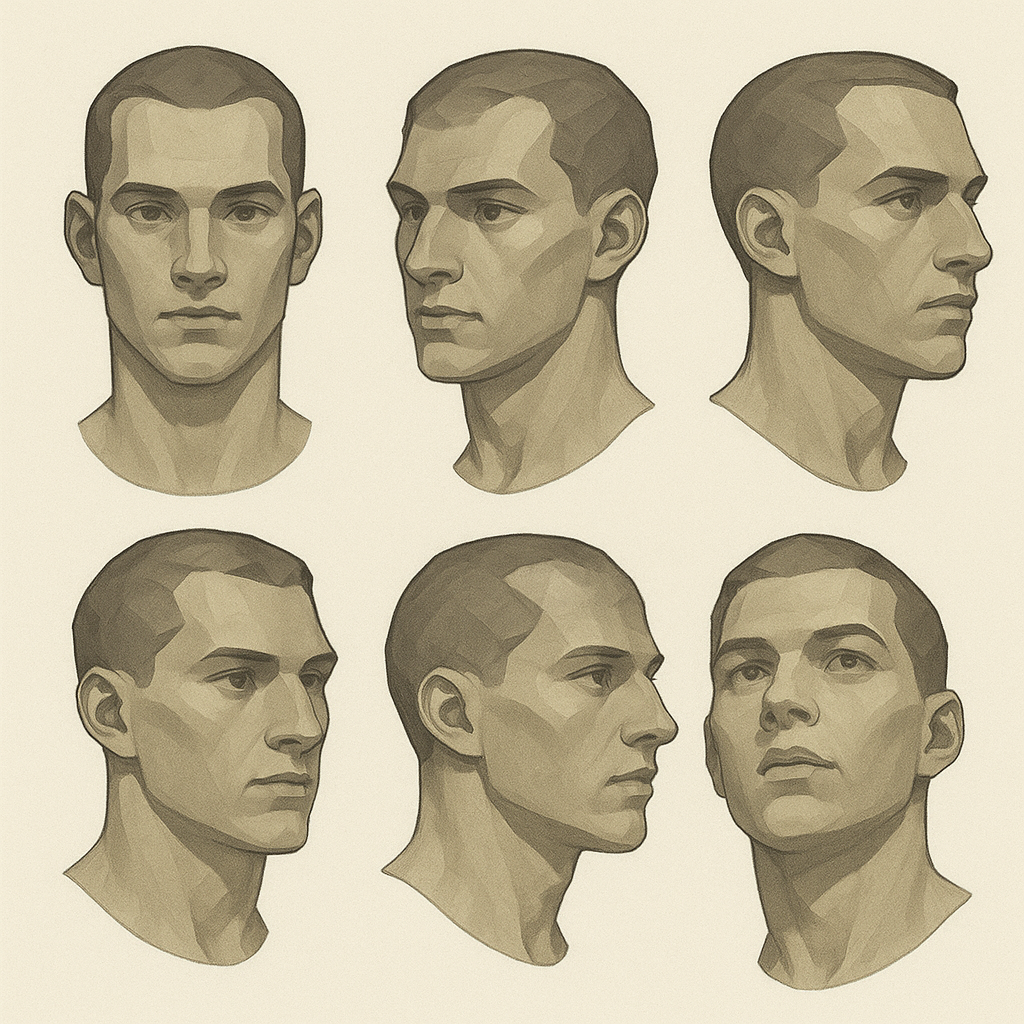
When you study the same head from the front view, from three quarter, from full profile, from the opposite three quarter, and from a slight up shot, your brain begins to connect those views into one mental object. The jaw stops being a line. It becomes a wedge that wraps around the skull. The nose stops being a triangle. It becomes a form with planes. Once your brain has that internal model, you can rotate the face without looking at a new photo. That is the skill clients pay for.
Angle work exposes blind spots
If you only ever draw three quarter, you can hide weak knowledge. Go to profile and suddenly you realize you never learned how far back the ear sits. Go to an up angle and you realize you never learned how the jaw connects under the ear. Each new angle shows you exactly what part of the skull you never really understood. That is valuable. It gives you a to do list for improvement instead of a vague feeling of I am bad at heads.
Angle study kills symbol drawing
Symbol drawing is when you draw an eye like a cartoon almond shape no matter what the angle actually is. Or you draw the mouth as one flat curve with two bumps. When you force yourself to draw the same face from five angles, you can no longer lean on symbols. The eyelid shape changes. The lips wrap around the muzzle of the face. The cheek volume shifts. Your brain gives up on shortcuts and starts thinking in planes. That is where style starts to feel believable instead of pasted on.
Lighting plus angle is the real unlock
Studying angles alone is strong. Studying angles under consistent lighting is even stronger. The planes of the cheekbone, brow ridge, and jaw react differently to light depending on rotation. When you hold lighting steady across every angle, you start to see which planes always catch highlight and which planes always fall away. That teaches you how to shade from imagination later, even when you do not have a perfect photo in front of you.
Why this matters for character work
If you design characters for comics, games, tattoo flash, VTuber models, or storyboards, you cannot afford to have your main character look like a new person every time the camera moves. Viewers notice. It breaks immersion. Being able to rotate the same face on command is the line between hobby sketches and production ready work. Consistency is marketable. Teams hire people who are consistent.
A simple training routine you can repeat
Pick one head and draw five fast views. Front. Three quarter. Profile. Reverse three quarter. Slight up angle. Keep it loose. Do not worry about hair at first. Then repeat the exact same five studies, but this time only block in light and shadow instead of full line work. Treat it like sculpting. You will build rotation skill and lighting skill at the same time in under an hour of practice.
Final thought
Drawing one cute face angle is impressive on social media. Drawing the same face from any angle is professional level control. The difference is not magic. It is structured angle study plus repetition. Train that and your characters will finally stay on model from panel one to panel twenty three.