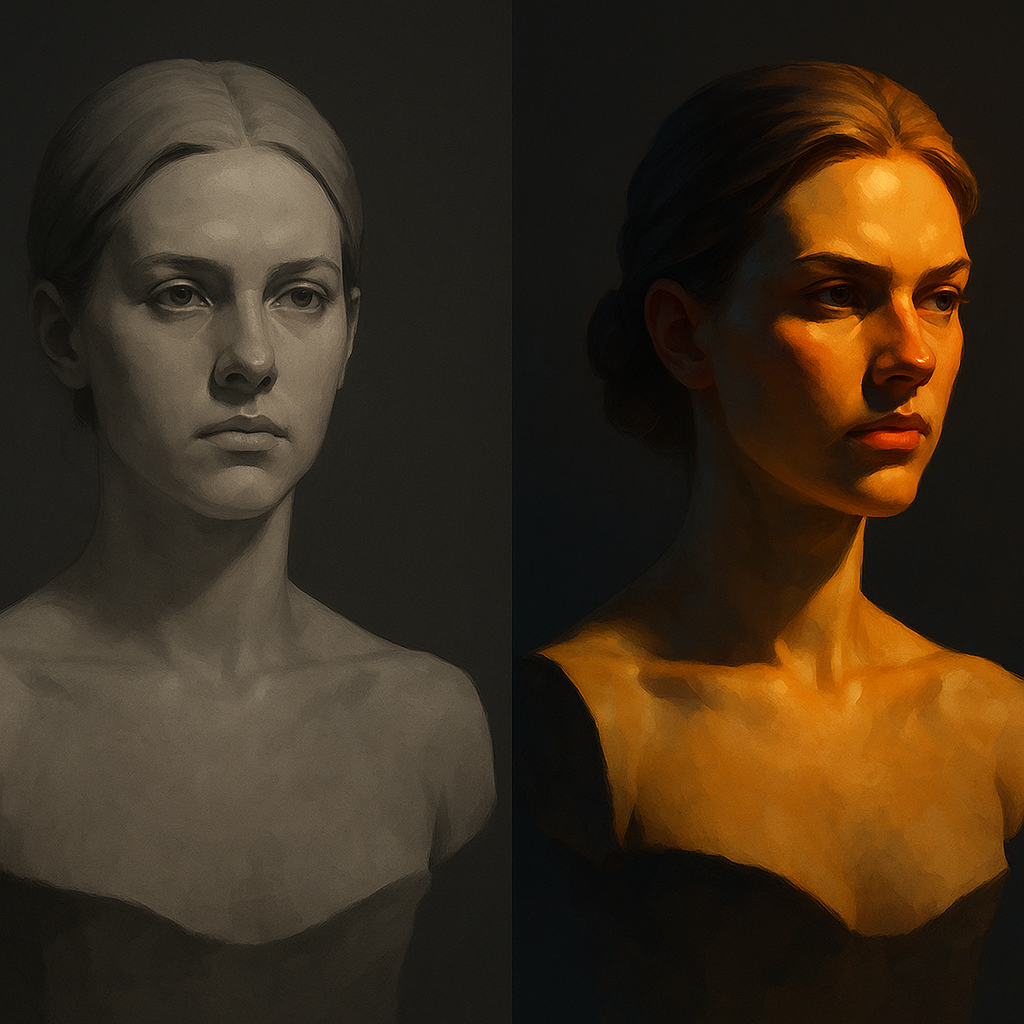
Lighting creates form, not line
Most new artists think in outlines. You trace the edge of the jaw, the edge of the nose, the edge of the neck. Professionals do not think in outlines. They think in planes of light. The top of the cheek catches a bright highlight. The eye socket falls back into shadow. The shape of the nose is defined by how it receives light, not by a black contour. Once you start reading light instead of tracing edges, you can paint believable form from any angle.
This is the real jump from beginner to professional level. You stop copying symbols and you start understanding structure. Light is the map that shows you where the face actually turns in space.
Lighting controls mood
You can take the same portrait and tell two totally different stories just by changing the light. Bright soft overhead light feels friendly, natural, and human. A narrow harsh light from below feels tense and dramatic. Nothing about the anatomy changed. Only the lighting changed. Lighting is emotion. If people say your work feels stiff or empty, it is often not because of anatomy. It is because the lighting is not saying anything.
Lighting tells the viewer where to look first
Strong art has clear focus. Your eye knows instantly where it is supposed to land. That is not luck. That is lighting control. Professionals put the highest contrast and brightest value on the focal point, like the face or the hands, and let other areas fall into softer light. Beginners light everything evenly and the eye has nowhere to rest. If you want your work to read fast and feel intentional, decide what matters most in the scene and light that first.
Common lighting mistakes that hold artists back
There are a few patterns that show up over and over. One, everything is lit the same, which makes the subject look flat. Two, shadows are just gray instead of carrying color from bounced light. Three, the light direction changes from feature to feature, so the piece feels subtly wrong even if the viewer cannot explain why. Four, everything is over blended with a soft brush, so there are no crisp edges where hard light should hit. These mistakes are not talent problems. They are lighting problems.
Why controlled lighting accelerates growth
Random screenshots and selfies have chaotic lighting. The light might come from five sources at once. The face may be filtered flat. The result is that you end up guessing. When you study from a controlled light setup, you can finally see clean planes, sharp cast shadows, and real edge transitions. You know exactly where the form breaks. You know exactly where a highlight dies. It is honest information. Honest information lets you build confidence fast.
This is why training with consistent lighting feels like a cheat code. You spend less time fighting the reference and more time actually learning how faces and bodies turn in space.
Final thought
Lighting is not garnish at the end of a painting. Lighting is the structure that everything else sits on. If you start treating lighting like the main event instead of the afterthought, your work will level up faster than any new brush pack or anatomy tutorial.